There was a place Aetheria Sinclair had never set foot upon, yet it refused to remain merely a place. It bled into the hollow of his ribs, settling there as a second heartbeat. How that memory first took root, and by what means, remained a question without answer. When he was a child, one of his teachers remarked, "From the age of three, he insisted that he came from 'there.' We simply assumed it was a common phase of early development, the kind of fantasy many children have. But whenever anyone looked at him with even a shadow of doubt, he would clutch his chest and weep as if the world had crumbled. So, we let it pass and believed it would fade naturally as he grew older.”
The memory, however, did not fade. It lived in the very centre of his brain like a pulse that never stilled. From the moment his fingers could grab a coloured pencil, he had begun reproducing that ethereal, dreamy world. On the day his early works were exhibited in a small gallery tucked away in the woods, on the day his images first met the outside world, people stood frozen before them, breath caught in their throats, as though they had stumbled upon something sacred and forbidden all at once. Who could have possibly imagined a world like this?
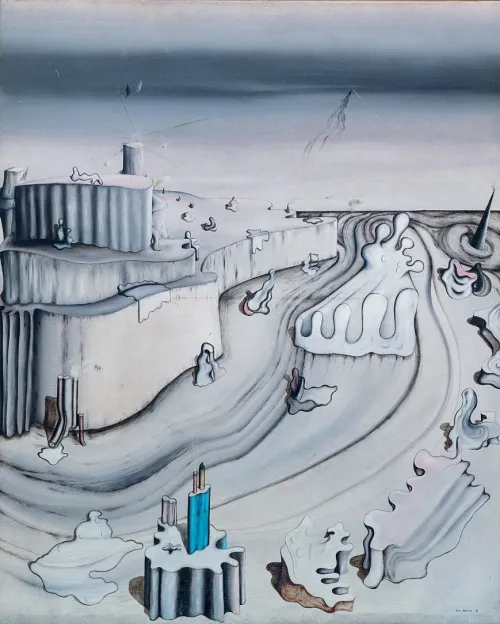
Aetheria's early paintings were rather abstract. A thicket of pastel blues and violets that seemed to bleed into one another like watercolours caught in rain; within this world, creatures of distinct forms coexisted alongside compositions of shapeless energy. The planet was mostly ocean, and within those waters floated bioluminescent algae that stained the sea, in shifting gradients of phosphorescent light of cyan, lavender and silver, pulsing like a slow heartbeat. More complex life inhabited the depths and the air, beings with fractals and enigmatic geometric patterns that formed an ecosystem all their own. Short days and long nights relentlessly passed; each time the sun rose and set, the landscape brimmed with an uncanny amethyst horizon melting into rose-gold skies and shadows that moved with a will of their own.
As Aetheria got older and odder, his depiction of the planet grew sharper and more precise. It was then that he began to express it not just on flat surfaces but through an immersive VR space. People constantly praised the vividness of this alien world, yet Aetheria’s reaction was rather lukewarm. "Of course it is," he would say. "The planet truly exists in this universe, and I merely paint what I see directly."
The planet resembled no place on Earth and seemed to exist in complete isolation from everything familiar to human beings. And yet it stirred an inexplicable feeling. When people gazed upon Aetheria's planet, tears would fall, as though they were remembering something left behind, something ancient and tender, something they had departed from long ago.
Aetheria spent more time lost in reverie than he did holding a brush. The memory of that world was a fierce breath that governed him from childhood until the end of his days. It was a world that should exist somewhere even though it couldn’t be found on any map. He painted its landscapes his entire life. Every canvas depicted a different scene, yet each fragment, when assembled, formed a breathtakingly intricate world.
"Aetheria, please do tell us the name of that place" reporters would ask, insistent. And he would always look troubled. "The name exists in my mind," he would answer, "but it is closer to a kind of energy. I doubt words can capture it"
The unnamed planet. People began to call it simply ‘Aetheria's planet.’
There were other works as well, lesser known. A series of paintings bore the title "Do Not Leave Me," and they were far more ambiguous and abstract, expressing emotion through colour alone. These pieces didn’t have his typical meticulous details. They were submerged in a lonely atmosphere and pleaded earnestly for something. After his death, dozens of works carrying the same title were found in his studio.
Upon leaving this world, he had arranged that anyone could freely use his creations. People longed for Aetheria's world and made it their ideal, a realm that gave them comfort. It seemed destined to dwell forever in the hearts of all who beheld it.
Until the day that world was actually discovered.
°°°
It happened when a space telescope, drifting through the vast cosmos, transmitted a set of data back to Earth. It concerned a small planet with a peculiar orbit. The atmospheric composition revealed an exquisite mixture of ammonia and methane, and given the presence of ultraviolet radiation, the prevailing assumption was that carbon-based life must exist on its surface. When the electromagnetic spectrum was converted into visible light, an enigmatic blue hue appeared.
"Wait... that data. Doesn't it look exactly like the Aetheria's planet?"
"No, it can't be."
"Think about it: Aetheria's planet exists as a simulation, complete with concrete measurements scientists have already verified. And now this data matches perfectly.”
That night, the astronomers could not sleep. Could this truly be Aetheria's planet? And if so, how could Aetheria have possibly known of its existence?
More data soon twisted their guts. The planet had already been consumed long ago by a cataclysmic explosion of its parent star. The light the telescope had received was the planet's final moment, just before annihilation. A scientist spoke: "We are looking at a world that has already vanished. Aetheria's world, once real, now gone."
°°°
Around the time this strange news began travelling across the world, a research facility called ‘Brain-Machine Interface Institute,’ nestled beside a remote lake, was brightly lit. Lead researcher Silvia sighed heavily, glaring at the computer screen before her like her eyes might burn holes through it.
"Does it make any sense at all," she muttered, "that a two-month-old infant would produce thoughts like 'Life is lonely and frightening. I miss my companions'?"
Hannah, who stood beside her, answered casually, "A month ago it was a cat. Now it's a human baby."
"Cat or baby, dead or alive. They cry because they're hungry, they cry because they're sleepy, they cry because they're scared. That's just what life is." Hannah gave a small laugh. "How can we be so sure? For all we know, a cat might be more philosophical than a baby."
According to the machine, the babies' cries meant:
"How can we get a deeper sense of ethics and love?"
"Is everyone doing well over there?"
"No, the place we chose is here."
Everyone stared at the analysis screen with dazed expressions.
"...It must be data contamination." Considering the principles of the brain imaging system, contamination was reasonable. The translation was still rudimentary, easily influenced by noise.
Silvia said, "So it's noise. If it's not noise, then interpreting an infant's cry should at most yield 'hungry' or 'uncomfortable.' Only expect primal instincts. That would be normal."
Hannah nodded. "It should be. But I got suspicious points that can't be dismissed as mere contamination. Look. Even among slightly older children who have started to speak, their thought patterns don't match their words. Which means, it shows a child who says, 'Mommy, give me that' while actually thinking, 'I am searching for the feeling of being connected to the world.'"
Silvia replied, "Couldn't it be just because the brain activity patterns of infants are radically different from those of adults?"
"Then we might have to start over," Hannah said, drowning in her works.
They were at the point where analysing adult patterns would have been easier. The research team continued to clutch their heads over the results that suggest infants were engaged in high-level conversations. Infants with complex, profound, philosophical wailing... they must have an old, wise man inside their brain cells.
Just as the research seemed to be losing momentum, Hannah pushed her computer forward, biting her lip slightly.
"Silvia, look at this."
"What on earth..."
"Exactly what you're seeing. Do you remember the day Aetheria's planet was discovered? The recordings from that day all came out like this."
The results read:
"We have begun there."
"We miss our planet."
"Aetheria."
"Aetheria."
"Aetheria painted it exactly as it was."
"We miss it so bad"
Something was communicating inside the babies’ brains. It appeared as if multiple independent beings existed within a single mind and exchanged thoughts. They even spoke of morality, of human life, of the true nature of the universe.
"There is something non-human inside the brains of these infants," Hannah said.
"It's just noise."
"It makes no sense. It's just a futile hypothesis."
Beyond their expectation, the data was consistent, from newborns to children who were just beginning to say words. The outward cries, when interpreted through the brain's semantic patterns, output the results of high-level thought. And it seemed as if multiple selves were conversing inside a single individual's mind. The researchers decided to call that mind "Them." "They" discussed emotions, the heart, love and oneness. They were indeed trying to teach the infants something. But after the age of three, the patterns of "Them" diminished sharply, and around the time children began to express themselves clearly, the traces of "Them" vanished entirely.
Where did they come from? How did they leave the human brain? Any evidence to prove their existence?
°°°
"The children in the box," Silvia said a few days later, sprawled on the sofa. "Years ago, there was an experiment to test whether a caregiver's touch is essential for infants. Do you remember?"
Hannah's eyes widened. "Right, that child rearing experiment using nursing robots."
The experiment had kept newborns completely isolated from the outside world, raising them solely with robots. Despite an official approval, the ethical controversy was immense. Obviously, raising infants inside enormous incubators didn’t seem good.
"The results were a total disaster, weren’t they?" Silvia said.
"Yeah. The babies acted only on instinct, with no sign of goodness or love. Fortunately, they recovered after escaping the boxes."
"But isn’t it weird? The nursing robots perfectly replicated human caregivers. In fact, human caregivers are imperfect, easily swayed by emotion and circumstance. So, what if the results had a different cause entirely?"
What if "Them" inside the brain were something that flowed in from the outside?
Silvia bolted upright and searched for footage from that old experiment. She extracted the audio data and fed it into the converter. The result appeared on the screen.
"Hungry."
"Sleepy."
"Scared."
°°°
Suppose that tens of thousands of years ago, some heterogeneous beings began a symbiosis with humanity. Just as mitochondria once entered cells and began a billion yearlong symbiosis carrying their own DNA separate from the nucleus, it is common for two species that started separately to live together for mutual benefit.
But what if the symbiotic partner came from a planet beyond Earth? What if they settled into our brains during early childhood and taught us? What if humanity itself, in truth, came from somewhere outside us?
"So, it was an alien nature all along," Silvia said, her voice flat with revelation.
Does a tangible form of "Them" exist, something we might recognise? Are they made of particles?
"Perhaps it's only natural they can't be physically observed. If they had a visible form, anatomy would have discovered them."
“I think it's kind of related to Aetheria's planet,” Hannah said. “'They' referred to Aetheria's planet as their home. Could it be that 'They' wandered the universe after losing their home and eventually arrived on Earth?"
Having predicted the fate of their world, ‘They’ drifted through space and finally reached Earth by chance, and their symbiosis with humanity began.
"What if we tried to speak directly to 'Them'?" someone suggested. But no one dared to act on it. When the consequences are entirely unpredictable, when the very act of conversation might provoke them...
"Wait... they aren't inside our brains now, are they?" someone asked.
Silvia came up with a different approach. "What if we show the infants the artwork? The Aetheria's planet?"
°°°
"It's just as we expected. The degree of brain pattern activation is... truly immense. Beyond analysis..."
The infants couldn’t tear their gaze from the moving landscapes. "Them" responded far faster than usual, and their patterns complex and layered with multiple meanings.
Hannah said, "Even if people feel repulsed by the existence of extraterrestrial life, it may not change anything. Would it even be possible to expel them from the brains of infants?"
"Looking at these analysis results," Silvia replied, "we should be begging them to stay. Because if they leave, we might lose everything we have always believed to be our humanity."
"I wonder how strong human ego will prove to be. But why do we feel we are completely separate from them? I want to say something still remain within us?"
Yet the data up to that point showed that "Them" appeared to live inside human brains only during early childhood, bidding farewell and leaving thereafter.
"Maybe related to childhood amnesia? After the age of seven, children forget most of their early memories," Hannah said.
"Until now, we thought the hippocampus was responsible for long term memory, and that memory loss in young children was linked to its development. New neural tissue..."
Silvia stopped mid-sentence. "Recent studies say otherwise. Neural development stages and memory loss are statistically unrelated."
Hannah's eyes lit up. "Then if the memories are being erased by an external factor, perhaps..."
"'Them'."
"They leave us and take the memories with them."
°°°
Aetheria was the only human who, even as an adult, remained aware of the existence of "Them" and their planet. The research team investigated the life of Aetheria Sinclair and found surprisingly little left behind. One fact was clear: his life had been profoundly solitary.
"Aetheria showed extraordinary talent for his artistic creation from a very young age. He possessed a delicate, sensitive heart. He must’ve listened closely to his inner voice. Perhaps he recognised the presence of 'Them' earlier than anyone else. It is even possible that 'Them' watched over him more specially," one critic said.
"Them" regarded the planet that Aetheria painted as something deeply sacred. Beings who had come to Earth from a world that vanished tens of thousands of years ago missed and loved their home. And at last, here was the single earthling who had succeeded in recreating that heavenly planet.
"Why do you think people were so enraptured by Aetheria's world?" Silvia asked.
"Because 'Them' once dwelled inside us," Hannah answered.
The traces they left in our brains. A memory or feeling so vague and abstract yet impossible to erase. That faint longing and tenderness for the beings who once taught and cared for us resonated within everyone.
Silvia spoke. "What about... that series of paintings? Does anyone remember it?"
"'Do Not Leave Me'... I actually loved that series even more than the planet one."
A brief stillness settled over the laboratory.
Then Hannah murmured, "They never left Aetheria. Not until the very end."
The planet Aetheria painted: a world of blue and bizarre colours. An ancient homeland that had coexisted with humanity for tens of thousands of years.
Silvia was suddenly overcome by an unfamiliar emotion, ineffable and achingly bittersweet, the energy of nostalgic longing for something ethereal. It rose in her chest like a tide, warm and sorrowful, as though she were remembering a dream she had forgotten upon waking. She blinked and found that her eyes were wet.